Créer des Agents IA Gratuits Sans Savoir Coder
30 janvier 2025Alex @puppyone
 Source de l'image : pexels
Vous êtes-vous déjà demandé comment créer des agents IA gratuits sans écrire une seule ligne de code ? Grâce aux plateformes no-code, vous pouvez maintenant construire des outils IA puissants sans avoir besoin d'expertise technique. Ces plateformes rendent le développement IA accessible à tous, des propriétaires de petites entreprises aux étudiants. Elles économisent du temps, réduisent les coûts et vous permettent de vous concentrer sur la créativité plutôt que sur le codage.
Le marché mondial des plateformes IA no-code croît rapidement. Par exemple :
- 60% des applications personnalisées ont été développées en dehors de l'IT en 2022.
- D'ici 2025, ce nombre devrait atteindre 70%.
Les outils no-code vous permettent de créer des solutions IA rapidement et efficacement. Que vous automatisiez des flux de travail ou construisiez des chatbots, ces outils le rendent possible.
Que Sont les Agents IA ?
Définition et Objectif des Agents IA
Les agents IA sont comme des assistants numériques qui peuvent penser, apprendre et agir indépendamment. Contrairement aux logiciels traditionnels, qui suivent des règles strictes, ces agents s'adaptent aux nouvelles informations et prennent des décisions par eux-mêmes. Ils sont conçus pour résoudre des problèmes, automatiser des tâches et améliorer l'efficacité dans des environnements dynamiques. Par exemple, un agent IA peut surveiller votre système, détecter des problèmes et les réparer sans avoir besoin de votre intervention. Cette autonomie les rend incroyablement utiles dans le monde rapide d'aujourd'hui.
You'll find AI agents in many areas, from customer service to fraud detection. They're built to handle repetitive tasks, freeing up your time for more complex work. Whether it's analyzing data or managing workflows, these agents are here to make your life easier.
Caractéristiques et Capacités Clés
Les agents IA viennent avec des fonctionnalités qui les distinguent. Voici ce qu'ils peuvent faire :
- Comprendre le contexte et se souvenir des interactions passées, rendant les conversations naturelles.
- Apprendre de chaque interaction en utilisant l'apprentissage automatique, donc ils s'améliorent avec le temps.
- Prendre des décisions par eux-mêmes, que ce soit répondre aux questions clients ou gérer des tâches.
These capabilities allow AI agents to deliver personalized experiences and adapt to changing needs. They don't just follow scripts—they think and respond dynamically. This flexibility is why they're becoming essential in industries like healthcare, finance, and e-commerce.
Real-World Examples of AI Agents
AI agents are everywhere, even if you don't realize it. In e-commerce, platforms like Amazon use them to recommend products, driving 35% of their revenue. In customer support, tools like Chatbase handle refunds and answer complex queries. Netflix uses AI agents to suggest shows based on your viewing history, while self-driving cars rely on them for navigation. Even in healthcare, AI agents assist doctors by analyzing medical images with impressive accuracy.
These examples show how AI agents are transforming industries. They're not just tools—they're problem-solvers that adapt and grow with you.
Avantages du Développement d'Agents IA No-Code
Accessibilité pour les Utilisateurs Non-Techniques
Les plateformes no-code rendent le développement IA accessible à tous, même si vous n'avez pas de formation technique. Ces outils présentent des interfaces intuitives glisser-déposer, donc vous pouvez créer des agents IA sans écrire une seule ligne de code. Que vous soyez analyste métier ou professionnel du marketing, vous pouvez construire des solutions adaptées à vos besoins.
For example, platforms like puppyone let you design AI agents that connect to databases, process information, and deliver results—all powered by AI agents and RAG (Retrieval-Augmented Generation). You can also use pre-built templates to speed up the process. This democratization of AI empowers employees across different departments to experiment with AI tools, fostering innovation and productivity.
Tip: Don't worry about coding errors or debugging. No-code tools handle the technical side for you, so you can focus on creativity.
Rentabilité des Outils No-Code
Building AI agents with no-code tools is budget-friendly. You don't need to hire expensive developers or outsource projects. Most no-code platforms offer affordable subscription plans, making them ideal for startups and small businesses.
Studies show that no-code solutions can reduce development time by up to 90%. This means you can create AI tools in minutes instead of months. By saving time and money, you can allocate resources to other important areas of your business.
- No-code AI reduces the cost of building AI models.
- It eliminates the need for a full-fledged development team.
- You can quickly adopt machine learning models into your processes.
Flexibilité et Options de Personnalisation
No-code platforms offer plenty of customization options, so you can create AI agents that fit your unique needs. Many tools come with pre-built templates, which you can tweak to match your goals. For instance, Bubble lets you integrate AI features like chatbots and data analytics, while Voiceflow helps you design conversational AI applications.
Here's a quick look at some popular platforms and their customization options:
| Platform | Customization Options |
|---|---|
| Bubble | Drag-and-drop interface, plugins for AI features (chatbots, data analytics, automation tools) |
| Adalo | Intuitive interface for mobile apps, pre-built integrations with machine learning models |
| Voiceflow | Design and deploy conversational AI applications, create dialogue flows, integrate machine learning |
| GPT-3 Playground | Experiment with OpenAI's language model, create chatbots and content generators by tweaking prompts |
| DataRobot | No-code machine learning capabilities, build and deploy models without programming experience |
These tools allow you to integrate AI functionalities, enhance user experiences, and optimize business processes. With no-code platforms, you can easily scale and update your AI agents as your business grows.
Guide Étape par Étape pour Construire des Agents IA
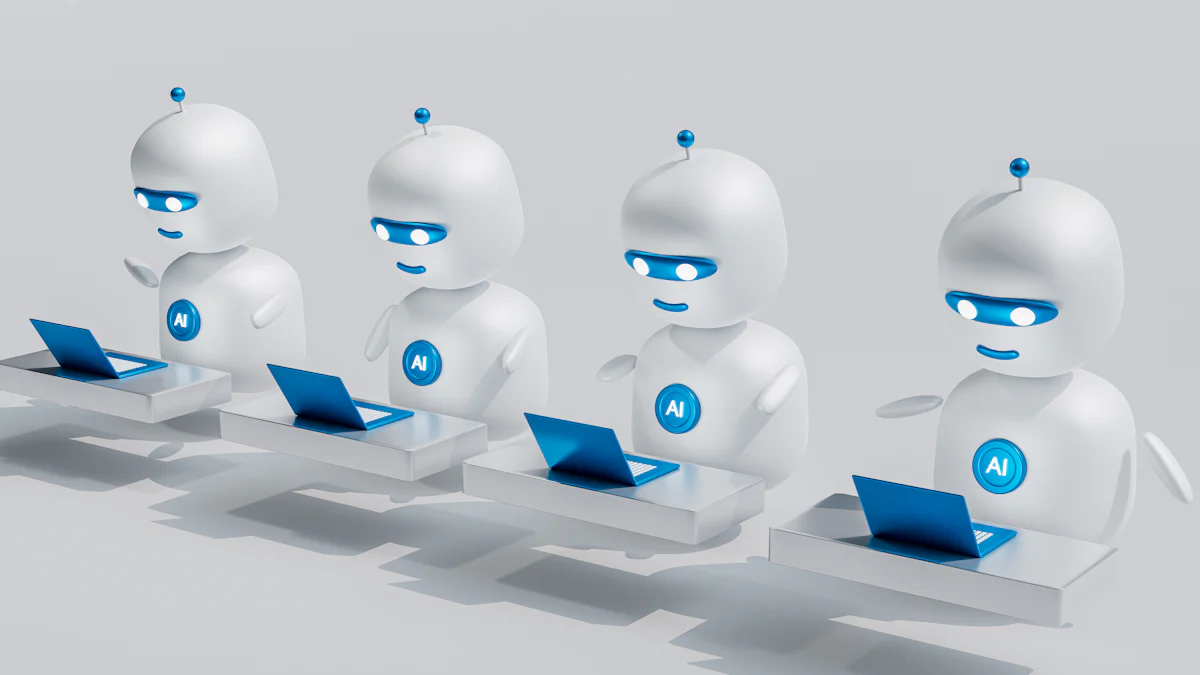 Source de l'image : unsplash
Choisir la Bonne Plateforme No-Code
The first step in building an AI agent is choosing the right no-code platform. With so many options available, it's important to pick one that fits your needs. Some platforms specialize in chatbots, while others focus on automation or voice-based AI. Here are a few popular no-code platforms you can explore:
- Bizway: Perfect for creating personalized AI workflows, especially for solopreneurs.
- Relay.app: Great for advanced automation and app integrations.
- Bubble.ai: Ideal for building intelligent web applications.
- Voiceflow: Best for designing voice and chat-based AI agents.
- ManyChat: Focused on marketing and customer engagement chatbots.
- Landbot: Helps you create interactive chatbots to boost user experience.
- Tars: Aimed at enhancing lead generation and customer support.
When selecting a platform, consider these criteria:
| Criteria | Description |
|---|---|
| Ease of use | Look for platforms with detailed documentation and active communities for support. |
| AI integration support | Ensure the platform supports AI features with clear implementation guides. |
| Design | Choose one with advanced design options for dynamic interfaces. |
| Scalability | Make sure it can handle increased user loads and database expansion as your needs grow. |
By evaluating these factors, you'll find a platform that aligns with your goals and simplifies AI agent development.
Définir l'Objectif et les Buts de Votre Agent IA
Before diving into the design, you need to define the purpose and goals of your AI agent. This step ensures your agent solves the right problem and meets user expectations. Follow these steps:
- Identify the Problem: What specific task or issue will your AI agent address?
- Prompt Engineering: Create prompts that guide your agent's behavior in different scenarios.
- Determine User Interaction: Decide how users will interact with your agent—via chat, voice, or another method.
- Establish Success Metrics: Define how you'll measure the agent's success, such as response accuracy or task completion rates.
For example, if you're building an AI agent for customer support, your goal might be to reduce response times by 50%. Clear objectives will keep your project focused and measurable.
Tip: Write down your goals and revisit them during the development process to stay on track.
Concevoir des Flux de Travail avec des Outils Glisser-Déposer
Once you've defined your goals, it's time to design workflows using drag-and-drop tools. These tools make it easy to visualize and build your AI agent's processes without coding. Here's how to get started:
- Efficiency: Focus on creating workflows that simplify tasks and save time.
- Customization: Use the platform's customization features to tailor workflows to your needs.
- Integration: Connect your AI agent with other apps or tools for seamless data sharing and task automation.
For instance, an AI workflow builder like Relay.app lets you integrate multiple apps to automate repetitive tasks. You can also use pre-built templates to speed up the process. These templates provide a foundation you can tweak to match your specific requirements.
Note: Test your workflows as you build them to ensure they function smoothly and meet your expectations.
Designing workflows is where your creativity shines. With drag-and-drop tools, you can experiment and refine until your AI agent works exactly how you want.
Ajouter des Sources de Données et Entraîner l'Agent IA
Now that you've designed workflows, it's time to add data sources and train your AI agent. This step is crucial because the quality of your data directly impacts how well your agent performs. Don't worry—it's easier than it sounds with no-code tools.
- Connect Your Data Sources: Start by linking your AI agent to the data it needs. Most no-code platforms let you integrate data from spreadsheets, APIs, or cloud storage. For example, you can connect a Google Sheet to provide customer information or use an API to pull real-time data.
- Organize Your Data: Clean and structure your data before feeding it into the agent. Remove duplicates, fix errors, and ensure consistency. Well-organized data helps your agent learn faster and perform better.
- Train the AI Agent: Use the platform's training features to teach your agent how to handle tasks. Many no-code tools offer pre-built templates to simplify this process. For instance, you can use a chatbot template to train your agent on common customer queries. Adjust the settings to match your specific needs.
- Test the Training: After training, test your agent with sample inputs. Check if it responds accurately and makes the right decisions. If something feels off, tweak the training data or settings.
Pro Tip: Start small. Use a limited dataset to train your agent initially. Once it performs well, scale up with more data.
Training is where your AI agent starts to come to life. With the right data and tools, you'll set a strong foundation for its success.
Tester, Itérer et Déployer l'Agent IA
Before deploying your AI agent, you need to test it thoroughly. Testing ensures your agent works as expected and meets user needs. Here's a step-by-step guide to this process:
- Run Simulations: Use the platform's testing environment to simulate real-world scenarios. For example, if you're building an AI agent for customer support, test it with various customer queries.
- Gather Feedback: Share the agent with a small group of users and ask for feedback. Find out what works and what doesn't.
- Iterate and Improve: Use the feedback to refine your agent. Adjust workflows, retrain with updated data, or tweak the design. No-code tools make it easy to iterate quickly.
- Deploy the AI Agent: Once you're satisfied, deploy your agent. Most platforms let you publish it with a single click. You can integrate it into your website, app, or other systems.
- Monitor Performance: After deployment, keep an eye on how your agent performs. Use analytics tools to track metrics like response time and accuracy.
Note: AI agent development doesn't stop at deployment. Regular updates and retraining keep your agent effective as your needs evolve.
Testing and deploying might sound technical, but no-code platforms simplify the process. With a little patience and creativity, you'll have a fully functional AI agent ready to tackle tasks.
Exemples de Cas d'Usage d'Agents IA No-Code
 Source de l'image : pexels
Support Client et Chatbots
No-code platforms have revolutionized customer support by making it easy to create AI-powered chatbots. These chatbots handle FAQs, process refunds, and even escalate complex issues to human agents when needed. You don't need to be a developer to build one. With drag-and-drop tools, you can design a chatbot that fits your business needs in no time.
For example, Shopify uses AI chatbots to manage support inquiries. These bots answer customer questions instantly, improving response times and customer satisfaction. They also reduce the workload for support teams, allowing them to focus on more challenging tasks.
Here's a quick look at how no-code AI agents enhance customer support:
| Benefit | Explanation |
|---|---|
| Accessibility for Non-Developers | No-code platforms let anyone create AI solutions without coding knowledge. |
| Reduced Development Time and Costs | You can build chatbots quickly and affordably, saving up to 90% of development time. |
| Customization and Flexibility | Tailor chatbots to your specific needs, ensuring a better user experience. |
| Scalability and Easy Iteration | Update and scale your chatbot as your business grows. |
These benefits make no-code tools perfect for building AI assistants that improve customer interactions.
Automatisation de Flux de Travail pour les Entreprises
Imagine automating repetitive tasks like scheduling, data entry, or email follow-ups without writing a single line of code. No-code AI agents make this possible. They streamline workflows, saving you time and money while boosting productivity.
Businesses of all sizes are adopting no-code tools for workflow automation. HR departments use AI agents for onboarding new employees and processing data. Marketing teams automate lead qualification and follow-ups. These tools are accessible, cost-effective, and highly customizable.
- Accessibility for Non-Developers: You don't need technical skills to create and deploy AI solutions.
- Reduced Development Time and Costs: No-code platforms cut development time significantly, making them budget-friendly.
- Customization and Flexibility: Tailor AI agents to your unique business needs.
- Scalability and Easy Iteration: Easily update and expand your AI workflows as your business grows.
With no-code AI, you can embrace advanced automation techniques and focus on what matters most—growing your business.
Analyse de Données et Rapports
Data analysis can be overwhelming, but no-code AI agents simplify the process. These agents gather data from multiple sources, process it instantly, and provide actionable insights. Whether you're analyzing customer feedback or tracking sales trends, these tools help you make informed decisions.
For instance, retail businesses use AI agents to evaluate purchasing patterns and customer preferences. This data shapes marketing strategies and improves product offerings. You can connect your AI agent to spreadsheets, APIs, or cloud storage to access real-time data.
No-code platforms like puppyone make building AI assistants for data analysis easy. With puppyone, you can connect to databases, process information, and deliver results—all powered by AI agents and RAG (Retrieval-Augmented Generation). You don't need programming skills to get started. Just link your data sources, and the AI agent does the rest. It's a game-changer for businesses that rely on timely insights to stay competitive.
Surmonter les Défis du Développement IA No-Code
Adresser la Fonctionnalité Limitée des Plateformes Gratuites
Free no-code platforms are great for getting started, but they often come with limitations. You might find that advanced features, like detailed natural language processing (NLP) settings or complex integrations, aren't available. This can make it harder to create unique applications or connect your AI agent to existing systems like CRMs or ERPs.
To overcome these challenges, start by clearly defining your project's requirements. Look for platforms that offer scripting or hybrid options to expand functionality. For example, some tools let you add custom code snippets to enhance your AI agent's capabilities. If performance becomes an issue, monitor your agent's resource usage and consider scaling up with paid features or alternative solutions.
Vendor lock-in is another common concern. Many platforms use proprietary systems, making it tough to switch providers later. To avoid this, choose platforms that allow you to export your data and develop an exit strategy from the start.
Assurer la Précision et la Fiabilité
Building AI assistants that perform reliably can be tricky, especially on no-code platforms. To ensure accuracy, you need to test your AI agent thoroughly. Start by defining clear testing goals. For example, if your agent handles customer queries, test it with real-world scenarios to measure response accuracy and speed.
Use automation tools to simplify testing and track critical metrics like response time and resource usage. Based on the results, tweak your workflows and retrain your agent as needed. Regular updates and optimizations will keep your AI agent performing at its best.
Remember, no-code tools make iteration easy. Don't hesitate to refine your agent until it meets your expectations.
Gérer la Sécurité et la Confidentialité des Données
Data security is a major concern when using no-code platforms. These tools often store sensitive information, which can make them vulnerable to breaches. To protect your data, use techniques like masking or pseudonymization. For example, replace names with placeholders or shuffle data to hide sensitive details.
Compliance with regulations like GDPR is also crucial. A privacy-by-design approach can help you embed security into your workflows. Limit access to sensitive data and train your team on best practices for handling information. Transparency is key—build trust by balancing confidentiality with clear communication about how your AI agent uses data.
By taking these steps, you can minimize risks and ensure your no-code AI agent operates securely and responsibly.
Creating AI agents has never been easier. With no-code platforms, you can skip the coding headaches and focus on bringing your ideas to life. These tools are designed for everyone, especially non-technical users like you. Whether you're a business owner or a creative thinker, you can now build AI solutions tailored to your needs.
No-code AI development empowers you to take control of your projects. You don't need to rely on developers or worry about technical jargon. Instead, you can use visual interfaces to design, test, and deploy AI agents quickly. This means you can experiment with ideas, automate tasks, and improve efficiency—all without breaking the bank.
The no-code movement is reshaping how to create free AI agents. It's not just about saving time or money. It's about giving you the tools to innovate and solve problems in ways that were once out of reach. So why wait? Dive into the world of no-code AI today and start building your own intelligent agents.
Tip: Start small. Use free tools to test your ideas and refine them as you go. You'll be amazed at what you can achieve!
Conclusion
Les plateformes no-code ont rendu la création d'agents IA accessible à tous—entrepreneurs, marketeurs et petites entreprises. Des outils comme puppyone permettent aux utilisateurs de construire des agents IA personnalisés gratuits sans coder, grâce à des flux de travail intuitifs glisser-déposer, des modèles pré-construits et des intégrations transparentes avec des applications comme Slack et Google Sheets. Que ce soit automatiser le support client, analyser des données ou rationaliser les flux de travail, la plateforme puppyone assure une sécurité et évolutivité de niveau entreprise tout en éliminant les barrières techniques. Prêt à transformer les idées en solutions IA ? Commencez à construire votre agent IA gratuit aujourd'hui—aucun développeur requis.