Collaboration in Multi-Agent Systems: A Practical Guide to Getting It Right
April 17, 2026Lin Ivan
Key takeaways
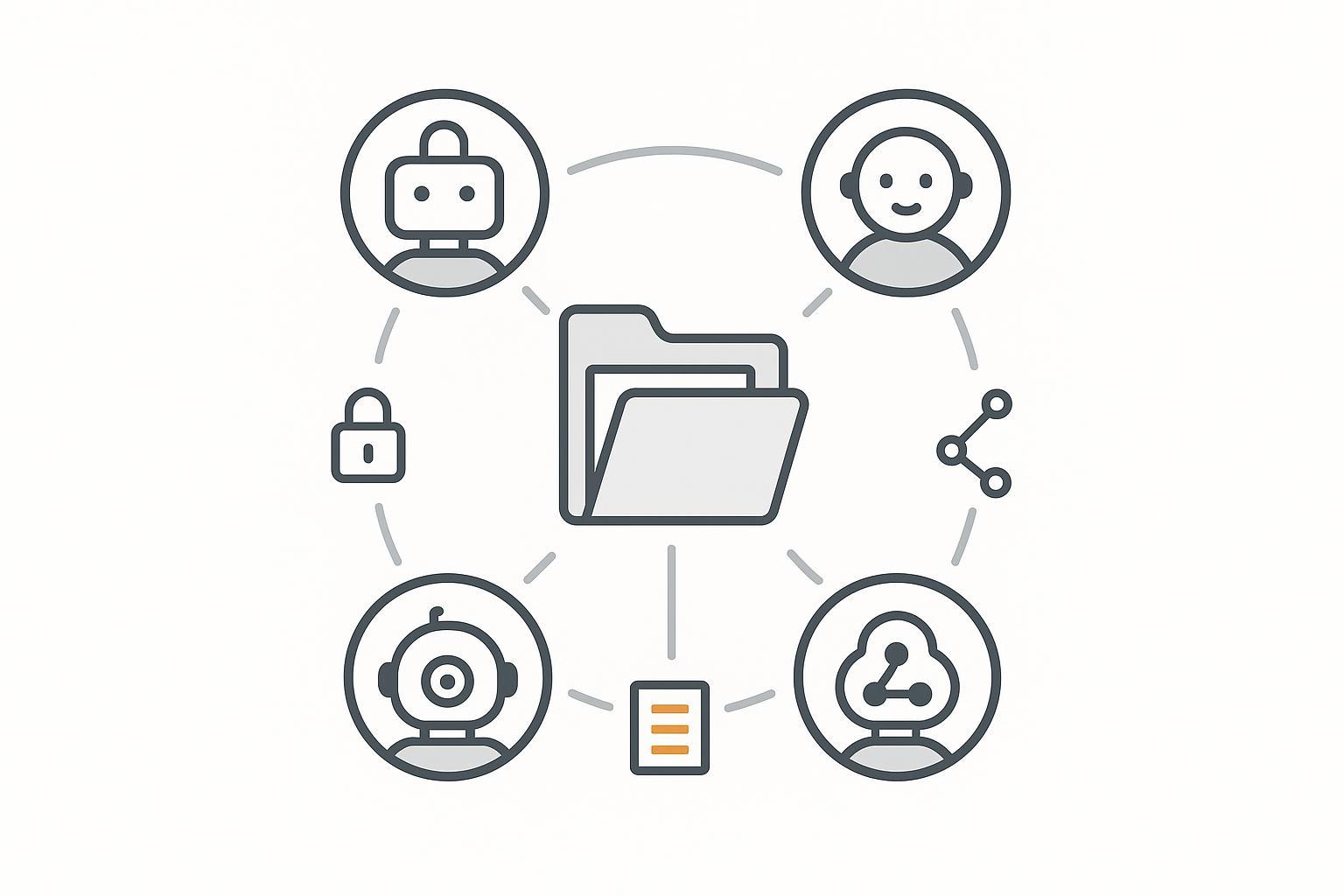
- Multi-agent collaboration is not just agents passing messages. It is a controlled workflow over shared context, shared tools, and shared operational state.
- The most expensive failures usually come from stale context, conflicting writes, permission creep, and weak rollback, not from one bad prompt.
- A protocol layer can standardize access, but it does not replace scoped permissions, mutation control, or version history.
- You do not need a heavy architecture for every prototype, but once agents start writing shared prompts, policies, runbooks, or memory, you need explicit mutation control.
- Mut matters when agents are not just reading context but continuously changing it.
The production mistake is thinking collaboration means "agents talking"
Multi-agent systems are attractive for a simple reason: one model rarely handles planning, retrieval, execution, verification, and governance equally well. Splitting work across agents can improve throughput and specialization.
But in production, collaboration fails for a more boring reason than most teams expect. It is usually not a reasoning problem first. It is a shared-state problem: different agents see different context, write to the same artifacts, inherit unclear permissions, and leave behind a trail nobody can reconstruct.
Google Cloud and IBM both describe multi-agent systems as multiple autonomous agents operating in a shared environment to solve problems together. That definition is directionally right, but it hides the hard part: once the environment is shared, collaboration becomes an engineering problem around context, boundaries, and change control, not just agent messaging (Google Cloud, IBM).
Anthropic's article on effective context engineering for AI agents reinforces the same lesson from a different angle: context is finite, and systems become more reliable when they retrieve and shape context deliberately instead of dumping everything into the prompt.
Multi-agent collaboration succeeds when teams treat shared context, permission scope, mutation control, and provenance as first-class system design problems.
What collaboration really means in production
A useful production definition is this:
Multi-agent collaboration is the ability for multiple agents to operate on shared business context without causing silent drift, unsafe actions, or irreproducible behavior.
That requires a small set of collaboration primitives.
| Primitive | What it controls | What breaks without it |
|---|---|---|
| Shared context | What all agents can rely on as true | Partial truths, stale answers, contradictory decisions |
| Task coordination | Who does what and in what order | Duplicate work, role confusion, unstable handoffs |
| Scoped permissions | Which tools, paths, and actions each agent may use | Overreach, accidental exposure, unsafe writes |
| Mutation control | How shared artifacts are edited, merged, and rolled back | Silent overwrites, broken prompts, policy drift |
| Provenance and audit | How you explain what happened after the fact | No accountability, slow incident response |
Most multi-agent systems that feel mysteriously unreliable are missing one or more of these primitives.
The failure modes that show up first
Context fragmentation
One agent uses a fresh policy from the official repository. Another agent relies on an old summary copied into a scratchpad. A third agent reads a Slack conclusion that was later reversed.
Every agent may behave "correctly" relative to its own input, yet the system is still wrong.
This is why context engineering matters. The problem is not that agents need more tokens. The problem is that they need the right context, at the right time, from the right source.
Parallel writes with no mutation layer
This is the failure mode teams underestimate.
If multiple agents can update prompts, runbooks, policy files, exception lists, tool configurations, or memory artifacts, collaboration is no longer just orchestration. It is a write-coordination problem.
Git can help when humans resolve conflicts interactively. Shared folders can work when writes are rare. But once unattended agents start editing the same operational surface, "last writer wins" becomes a disguised incident.
If that issue already feels familiar, the companion post on version control for AI agent context goes deeper on merge handling, scoped access, and rollback.
Permission drift
Early pilots often start safe:
- read-only access
- one connector
- a narrow toolset
Then exceptions accumulate. A temporary write path becomes permanent. A support agent gets access to internal analysis notes. A new integration lands without being mapped to a clear approval boundary.
At that point, the system still looks productive, but nobody can answer a basic question: what is each agent actually allowed to do?
No provenance when something goes wrong
Sooner or later, someone will ask:
- Which source was treated as the system of record?
- Which agent made this change?
- What exactly changed?
- Can we restore the previous state?
If the answer is buried across logs, prompts, and app-specific wrappers, collaboration has already failed the production test.
NIST's AI Risk Management Framework is useful here because it reinforces the need to incorporate trustworthiness and lifecycle controls into the design and operation of AI systems.
Give every agent the right context slice instead of one oversized shared promptGet startedA practical reference architecture for multi-agent collaboration
The cleanest production pattern is to separate concerns:
user goal
  -> planner / coordinator
  -> worker agents with narrow roles
  -> governed context and tool access
  -> review / approval / rollback layer
  -> final action or response
Each layer should answer a different question:
- Planner: what work is needed next
- Workers: which narrow task is being executed
- Context layer: which evidence and policies are authoritative
- Permission layer: what each agent may see and change
- Mutation layer: how shared artifacts are written, merged, and rolled back
- Approval layer: which actions need runtime review outside the model
This is also where a unified integration surface helps. If connectors and external systems are managed through a consistent abstraction, teams can reason more clearly about what data exists, where it came from, and which agents can access it. puppyone describes this in its Connections model and path-aware FLS permissions.
If you are still sorting out where protocol layers fit into this stack, MCP in agentic AI is the best companion read for the access-layer side of the problem.
When you need Mut, not just another orchestrator
This is the part many articles skip.
If your agents only read approved context and return suggestions to a human, you may not need a dedicated mutation layer yet.
If your agents continuously write to shared operational context, you probably do.
That context usually includes things like:
- prompt packs
- SOPs and runbooks
- policy files
- evaluation configs
- allowlists
- customer memory files
- internal playbooks
Once those files influence downstream agent behavior, they should be treated like production state.
That is where Mut becomes relevant.
Mut is useful when you need a version-management model designed around agent-written context, not just human-authored code. In practice, that means:
- path-scoped visibility
- attributable writes
- automatic or policy-driven merge behavior
- diffable history
- fast rollback when a context change degrades behavior
You can think of the boundary this way:
| Problem | Best control plane |
|---|---|
| Pipeline stages, approvals, promotion rules | Orchestrator or workflow engine |
| Shared prompts, policies, playbooks, memory writes | Mut or a Mut-like mutation layer |
| Path-level visibility and read/write boundaries | Permission system |
| Incident reconstruction and rollback | Audit plus version history |
This separation matters because teams often overload orchestration tools with problems they are not built to solve. A pipeline can decide whether a change may proceed. It does not automatically solve safe concurrent mutation of shared context.
The minimum controls that make collaboration trustworthy
If you are reviewing a pilot before scaling it, this is the minimum useful checklist:
- Canonical sources are explicit. Every workflow knows which artifacts are authoritative.
- Context retrieval is deliberate. Agents retrieve what they need instead of inheriting giant prompt dumps.
- Roles are narrow. Planner, worker, reviewer, and executor responsibilities are not blended together casually.
- Permissions are path-scoped. Agents cannot enumerate or mutate content outside their assigned scope.
- Writes are attributable. Every change can be tied to an agent, task, and time.
- History is queryable. Diffs, previous versions, and rollback targets are easy to inspect.
- Approval is externalized. Sensitive actions do not depend only on prompt wording.
- Incidents are reproducible. You can reconstruct which context and permissions were active at the time.
If you cannot meet most of these requirements, do not add more agents yet. Add clearer boundaries first.
The article on agentic workflow design is a good follow-up if your current problem is not agent count, but weak planning, approval, and execution seams.
Where puppyone fits without turning this into a sales pitch
The strongest reason to use a platform like puppyone is not "more AI." It is cleaner operational control.
For multi-agent teams, puppyone is useful when you need:
- one governed context layer instead of scattered copies
- path-aware access control for different agents
- explicit connector surfaces for external systems
- auditability around what context was used and what changed
That matters especially when collaboration spans both knowledge retrieval and context mutation.
If your current architecture is mostly ad hoc folders, fragile prompts, and tool wrappers, you do not necessarily need more autonomy. You need a more disciplined context surface. The puppyone guides on agent permissions and audit design and context version control are the best next reads from here.
Start with puppyone if your agent team needs scoped context, auditable writes, and rollback-ready collaborationGet startedFinal recommendation
Treat multi-agent collaboration as a governed shared-state system.
Do not start with "How many agents should we add?"
Start with:
- what context is canonical
- what each agent may read and write
- how shared artifacts are versioned
- how you roll back bad context changes
- how you explain decisions after an incident
If those answers are weak, more agents will amplify the weakness.
If those answers are solid, collaboration stops being a flashy demo pattern and starts becoming a production capability.
FAQs
Q1: Is a multi-agent system always better than a single-agent system?
No. Multi-agent systems increase specialization and parallelism, but they also introduce coordination cost, permission complexity, and more shared-state risk. If your workflow is mostly linear and read-only, a well-designed single agent is often the better choice.
Q2: What is the minimum shared context needed to make collaboration work?
At minimum, you need a canonical source of truth for policies, instructions, and current operational state, plus a defined update path so agents are not inventing their own truth from scratchpads and stale summaries.
Q3: When should I introduce Mut?
Introduce Mut when agents begin writing shared prompts, policies, runbooks, memory, or other behavior-shaping files that affect downstream execution. If humans still review and merge everything manually, Git may be enough. If unattended agent writes are frequent, you need stronger mutation control.