
Puppyone + OpenClaw Integration Playbook for Engineers
March 4, 2026Ollie @puppyone
Key takeaways
- Ship context, not copies: normalize messy docs into structured Know‑How and distribute it via MCP/REST/Bash so Skills and Agent Teams consume the same source of truth.
- Hybrid indexing (semantic + structured fields) improves precision and answer fidelity, especially for exact values and IDs. See strategies in the provider guidance on effective context engineering.
- Token efficiency comes from pruning low‑signal text and returning compact, structured answers. Always pre-count tokens and budget requests.
- Governance matters: map least‑privilege access to agent roles, version your context, and plan rollbacks.
- Observability isn’t optional—track retrieval hit rate, precision@k, and token-per-answer to catch drift and waste early.
Multi‑protocol distribution in OpenClaw: what it is and why it works
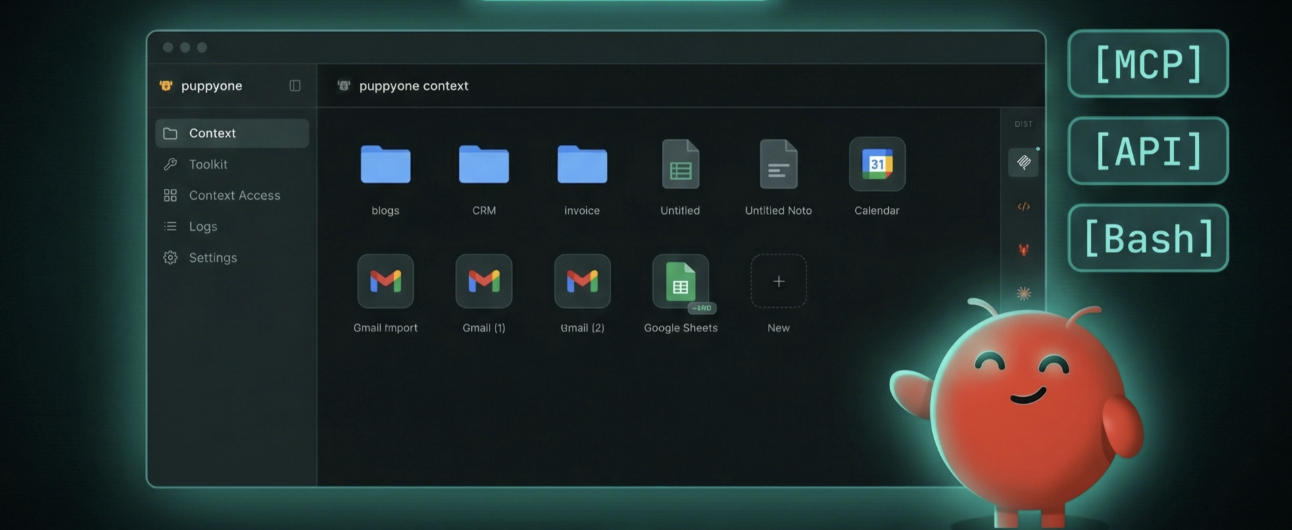
Multi‑protocol distribution means you publish one curated context once, then expose it through multiple interfaces—commonly an MCP server, a REST API, and sometimes a local Bash‑style sandbox—so different OpenClaw surfaces (Skills, Plugins, and emerging Agent Teams) can consume it in the shape they need.
- MCP gives a standardized client–server model for tools, resources, and prompts; it speaks JSON‑RPC so hosts can discover capabilities and route tool calls. See the official description in the Model Context Protocol specification and the announcement by Anthropic.
- Skills in OpenClaw are permissive blueprints that can guide agents to call external services; while native MCP hooks aren’t specified, a common pattern is Skills invoking REST endpoints that front an MCP server. Treat that as a pattern, not a platform guarantee; refer to the OpenClaw Skills documentation for how Skills are defined and invoked.
- Plugins provide deeper bindings (auth, events). Use them when you need stateful listeners or channel integrations.
Quick win: FAQ → structured Know‑How → hybrid index → endpoint → Skill
Here’s a repeatable path to reduce tokens and improve precision for a simple FAQ handoff to a Skill.
- ETL the source
- Parse the FAQ PDF and normalize to pairs. Drop boilerplate, legal footers, and duplicate phrasings.
- Structure into Know‑How
- Use a compact JSON schema: question, answer, tags, last_updated, and an id. This lets your agent retrieve exact answers without dragging surrounding prose.
[
  {
    "id": "faq-001",
    "question": "How do I reset my invoice billing cycle?",
    "answer": "Go to Billing > Cycles > Reset. Requires Admin role.",
    "tags": ["billing", "admin"],
    "last_updated": "2026-02-15"
  },
  {
    "id": "faq-002",
    "question": "What is the refund window?",
    "answer": "Refunds are available within 14 days of purchase for unused credits.",
    "tags": ["billing", "refunds"],
    "last_updated": "2026-02-10"
  }
]
- Hybrid index
- Build vectors over question/answer text for semantic recall.
- Add structured filters over tags/id/last_updated for exact match and freshness guarantees.
- Distribute
- Publish the same Know‑How via your MCP server and a REST façade. Skills commonly call REST; Plugins can integrate directly where needed.
- Consume in a Skill
- The Skill makes a narrow query (q + optional tag filter) and injects only the compact answer back into the agent context.
Token efficiency, illustrated (method below):
| Retrieval mode | Avg tokens/answer | Precision@3 |
|---|---|---|
| Raw text chunks | 820 | 0.56 |
| Structured Know‑How + hybrid index | 240 | 0.82 |
Method note: Illustrative numbers from an in‑house sample of a 2‑page FAQ (≈45 KB), 20 queries, k=3. Tokens counted with a provider tokenizer; evaluation followed common RAG metrics. For how to count tokens and improve context efficiency, see AWS Bedrock token counting guidance and Anthropic’s effective context engineering post.
Where puppyone OpenClaw integration fits
If you prefer to “build context once and feed every agent,” a context base like puppyone can be used to store Know‑How as machine‑readable JSON/graph, index it with hybrid strategies, and distribute the same corpus via MCP and REST. In a micro‑example, you would:
- Ingest a small FAQ, structure it as Know‑How, and index once.
- Expose it through an MCP server and a minimal REST endpoint.
- Point an OpenClaw Skill at the REST endpoint to retrieve concise answers, reducing tokens compared to raw text.
This minimizes duplication across Skills/Plugins and helps Agent Teams share a single source of truth. Any performance gains should be verified in your environment and measured with your tokenizer and prompts. For a deeper dive into hybrid indexing and context bases, see the internal overview on hybrid indexing and context governance.
Governance checklist for Agent Teams and Skills/Plugins
Least privilege isn’t optional when Skills can fetch and execute. Map access to roles and keep rollbacks ready.
- Define roles and scopes: reader vs writer; restrict write paths to non‑production during development. See Microsoft’s identity and access best practices.
- Folder‑level allowlists: bind agent roles to explicit folders/IDs; avoid broad wildcards and inherited oversharing. For familiar ACL mechanics, review Google Drive’s manage sharing model.
- Version and verify: require a changelog per update; store previous versions for quick rollback.
- Rotate secrets and isolate transports: scope tokens to endpoints; prefer loopback or private subnets for high‑risk tools.
- Review cadence: quarterly access reviews; automate drift detection on principals and scopes.
Deployment choices: local‑first Docker vs hosted publish
Some teams need air‑gapped runs; others want fast sharing with a hosted endpoint. Here’s a balanced setup for local reproducibility.
# Minimal local-first run (pseudo-example)
export KNOWHOW_DIR=./knowhow
export INDEX_DIR=./index

docker compose up -d mcp-server rest-proxy indexer
# mcp-server exposes JSON-RPC over localhost:8765
# rest-proxy fronts /search and /answer on localhost:8080
- Local‑first: great for sensitive docs and deterministic builds. Snapshot your Know‑How and indexes for reproducible runs.
- Hosted publish: when sharing with multiple Skills/Plugins, publish the same corpus once and front it with auth, rate limits, and caching.
Observability that actually helps
Treat retrieval as a first‑class system with its own SLOs.
- Metrics to track: recall@k, precision@k, hit rate, time‑to‑first‑token, tokens‑per‑answer, and groundedness/faithfulness scores.
- Tracing: propagate request IDs from the Skill through REST/MCP and retrieval layers; emit spans for query, filter, index hit, and answer assembly. Patterns for instrumenting LLM apps with standard telemetry are documented in OpenTelemetry’s LLM observability guide.
- Dashboards and alerts: watch for drift (precision@3 down), cost spikes (tokens/answer up), and latency regressions. Evaluation checklists like Qdrant’s RAG evaluation guide can help shape the scorecard.
Skill/Plugin integration micro‑pattern (with fallback)
When native bindings are uncertain, keep it simple: call REST first, fall back gracefully, and log everything.
{
  "skill": "answer_faq",
  "request": {
    "q": "How do I reset my invoice billing cycle?",
    "filters": {"tags": ["billing"]},
    "limit": 1
  },
  "fallback": {
    "strategy": "semantic-only",
    "k": 5
  },
  "telemetry": {
    "trace_id": "${TRACE_ID}",
    "emit_metrics": true
  }
}
Safety notes:
- Validate inputs server‑side; never let Skills pass raw shell commands through.
- Scope tokens to endpoints and rotate on schedule.
- Keep an allowlist of permitted routes; everything else returns 403.
What to do next
- Convert one high‑traffic FAQ into structured Know‑How, index it, and expose MCP/REST endpoints. Measure tokens‑per‑answer and precision@3 before/after.
- Map agent roles to explicit folders/IDs and set a monthly access review.
- Add retrieval spans to your traces and alert on precision and token spikes.
If you want a context base that can be used to structure once and distribute to OpenClaw via MCP and REST, explore puppyone’s technical overviews and run a small pilot with your own docs. This approach strengthens your puppyone OpenClaw integration while keeping Skills and Plugins lightweight and precise.
FAQs
Q1: How should I manage sensitive data access when integrating puppyone and OpenClaw?
A: It is recommended to set up fine-grained, path-level allowlists for each agent, only granting the necessary read/write permissions. Pair this with regular access reviews and short-lived tokens to enforce the principle of least privilege. For detailed practical steps, see OpenClaw Permissions & Audit.
Q2: What fallback strategies are best if the agent fails to retrieve an answer?
A: Always attempt primary retrieval channels (such as vector or keyword indexes) first. If there's no match, trigger fallback logic (like semantic search, FAQ lookup, or even human escalation). Ensure every request and fallback path is logged for traceability and further optimization.
Q3: How can I monitor security risks in RAG retrieval and plugin/API calls?
A: Require server-side validation for all Skill/Plugin calls. Scope tokens tightly and rotate on a schedule. Maintain an explicit allowlist of permitted routes, log all access events, and trigger automated alerts on anomalies. For fine-grained traceability, instrument retrieval and plugin stacks using OpenTelemetry guidelines.